

2026-2027 Age group change
faq
1. What is the age group cut-off for team registration for 2026 and how is it different?
Beginning with the 2026–2027 season, age group cut-offs will shift to August 1 – July 31. This is a change from the previous cut-off of January 1 – December 31.
This change will impact:
- All
CSA League, GA, EA, ECNL and DPL teams.
- MLS Next Homegrown will continue using the January 1 – December 31 cut-off.
2. Why are the age group cut-offs changing?
US Club Soccer (US Club) and US Youth Soccer (USYS) are implementing this change to:
- Increase participation at younger age levels.
- Keep more players in the game as they progress through high school.
- Align with the nationwide youth soccer season (August 1 – July 31).
- Better match school calendar years, allowing more players to compete with classmates, enhancing both social and developmental experiences.
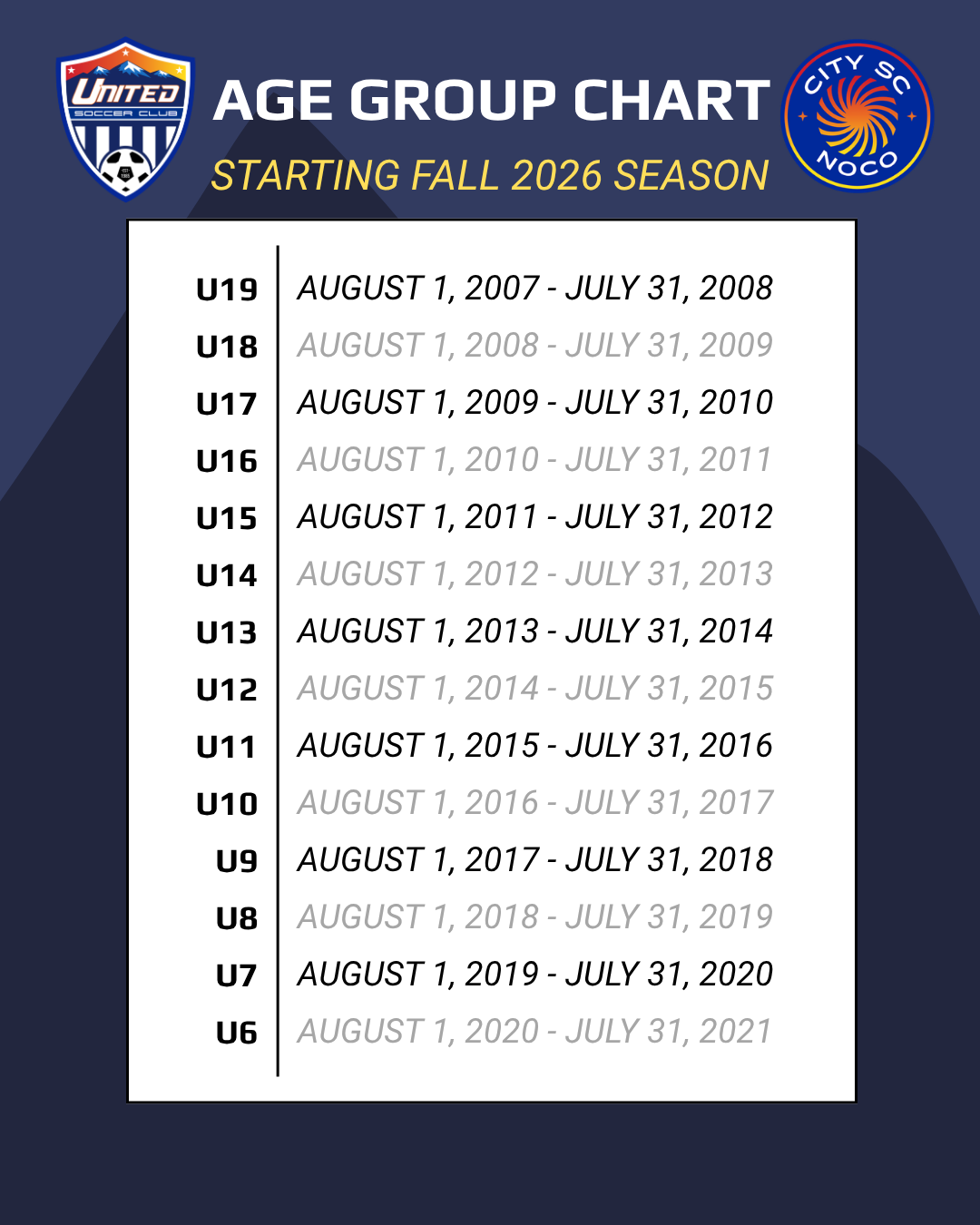
3. How is United SC / City SC NOCO preparing for the change?
The club is working diligently to ensure a smooth transition for all players and families. Our preparation includes:
- Auditing all rosters to confirm each player’s appropriate age group.
- Scheduling internal age group training sessions to allow players and coaches to become familiar with new player pools.
- Providing ample opportunities for players to be evaluated within their new age groups.
- Finalizing coaching assignments earlier than usual to allow staff time to work with new groups.
Our goal remains the same: to form competitive teams at every age group and place players in environments that best support their individual development.
4. What is the purpose of the in-house age group training sessions?
In-house age group training sessions are designed to:
- Help players transition into their new age groups.
- Build chemistry and relationships within new player pools.
- Give coaches early exposure to players prior to tryouts.
These sessions support both competitive placement and long-term development.
5. When will coaching assignments be released?
United SC / City SC NOCO is working to finalize coaching assignments earlier than in past years.
- Younger age groups (U7–U9) will be announced first.
- Older age groups will be finalized and published ahead of their respective tryout periods.
6. What are the benefits of a player “repeating” an age group?
Repeating an age group can offer several developmental benefits:
- Technical Development
- Players receive more touches on the ball and increased involvement in play, particularly at 7v7 and 9v9 levels, which supports preparation for 11v11.
- Physical Development
- Late-developing players may benefit from competing in a more physically appropriate environment.
- Confidence and Social Development
- Players may gain confidence, leadership opportunities, and benefit from a supportive learning environment.
7. What is the club policy on players “playing up”?
United SC / City SC NOCO’s policy on playing up remains unchanged.
- Playing up is evaluated
case by case.
- Decisions are made by coaches and directors based on what is in the best interest of the player.
- Most players benefit from competing in their true age group.
- Requests to play up must be approved by club leadership.
Factors considered include physical development, technical ability, social readiness, and long-term player growth.
8. Can my child try out for multiple age groups?
- Players are required to try out for their true age group based on the August 1 – July 31 cut-off unless pre-approved by coaches to try out in an older group.
- Players are not permitted to play down in a younger age group, as this violates league rules.
9. Will I have to purchase a new uniform?
- Yes. This change aligns with the club’s 2-year uniform cycle.
- All players (new and returning) will be required to purchase a new kit for the upcoming season. Uniform cycles are aligned with manufacturer production to ensure consistent availability and quality.
10. How will jersey numbers be assigned?
The club will reassign jersey numbers to avoid duplicates within each age group.
This system:
- Allows flexibility for roster movement.
- Prevents conflicts.
- Avoids unnecessary uniform repurchases.
Special consideration may be given to older players involved in the college recruiting process.
11. What are the primary benefits of the new age group system?
- Social Development
- Players are more likely to compete with classmates, building stronger relationships and a better overall experience.
- Continuity and Fair Opportunities
The new system reduces: - “Trapped players” who are isolated between school and soccer calendars.
- “Forced ups” where players must play above their biological age to stay with classmates.
Overall, the August 1 – July 31 model places more players in the right environment at the right time, improving development, retention, and enjoyment of the game.